Thoughts on current events, including but not limited to, the computer & automotive industries; British, American, & World politics; Space Exploration; and the military.
I don't claim to be an expert on anything, and I'm not receiving any revenue from this blog.
Comments are welcomed but I'll delete any I find offensive or any I determine to be off-topic or some form of advertising.
Privacy and security seem to be on everyone's mind today. Which makes sense, because cybercriminals are constantly on the attack.
It doesn't matter if you're waiting for a connecting flight at the airport or in the comfort of your own home, hackers will find you. They might be watching your every move over public Wi-Fi or trying to get an up close and personal look at you through your webcam.
No matter what the situation, you don't want critical data falling into the wrong hands. Fending off these attacks is something everyone should know how to do.
That's why we're going to tell you about five must-do spy hacks you didn't know until now.
1. Stop your Smart TV from spying on you
Of all the "smart" devices, few are more controversial than the smart TV. The idea makes a lot of sense: Combine the best parts of a computer and a television into one super-machine. What could go wrong?
Well, as popular as smart TVs are – especially in the luxury tech department – many critics dislike the format, and the technology is surprisingly susceptible to ransomware. Companies have had to defend their inventions again and again and compared to simpler and less expensive forms of entertainment, the smart TV is struggling to earn its place in your family room.
The latest issue: privacy. Certain models keep tabs on their owners in uncomfortable ways, and there's really no good reason for this kind of shifty behavior.
Psst! Smart TVs tend to be a target for hackers. Listen to Kim's free podcast to hear why you should be worried and what you can do about it by clicking the link below.
That's just one of the great topics from the Komando On Demand Podcast, but Kim shares a new podcast each week on her site and on iTunes and Google Play.
You've probably heard us talk about being tracked by companies like Facebook and Google. They say the purpose is so they can provide you with targeted ads.
That might be the case but the amount of information Google actually has on you is shocking! If you use Google services, it has more information on you than you think. That means Gmail, Google+, Google Contacts, Google Docs, Google Calendar and other Google applications, along with Android.
The good news is that you can find out how much of your information has been logged with Google so you can take steps to get rid of it. The better news is that you can download all that information to your computer for your personal records so you don't lose it in the cleanup.
Are spying apps a good thing? Honestly, it depends on who's doing the spying.
They're a great way for parents to make sure their children are staying safe online. But, in the wrong hands, they can become problematic.
There might be an app on your phone right now sending all your calls, texts, photos, and more to who knows? So, if someone you know seems to know a little too much about your life, they could be spying on you right now.
Smart assistant enabled speakers like Amazon's Echo, and Echo Dot can be extremely helpful around the house. You can use them to control smart appliances, lights, listen to music, get the daily news and so much more.
However, there are some privacy concerns that you need to be aware of before bringing them into your home. One is the fact that Alexa is always listening. It listens constantly to hear the "wake word" so it can perform whatever function that you need.
When you're walking out the door for a vacation or even just a normal workday, it's easy to be thinking about what's ahead, not what you're leaving behind. Sure, you locked the doors, but what if you want to check up on your home while you're gone?
Most people don't think about setting up a monitoring system until they're already out of the house. An internet-enabled security camera will do the trick, but most people don't bother buying and installing one, even though they should.
If cost or complexity is holding you back, I have a less-expensive solution. You probably have a webcam for your desktop or laptop computer, which means you already have almost everything you need for serious spy-grade home surveillance (when you and Fido simply can't be there to secure the home front old-school style).
Bonus: Stop hackers from spying through your webcam
Now that you've learned how to use your webcam as a surveillance tool, you should also know how to protect yourself from having the tables turned against you. Webcam hacking is a real threat facing computer users every day.
Believe me, you don't want hackers taking over your webcam and watching your every move. That's creepy!
A webcam cover is the easiest way to prevent your webcam from being used to spy on you. Simply slide it over the camera and it's all set.
You're going to love this one! There's no better webcam cover to own, this is deep blue with the Kim Komando Show logo printed on it. Just like Kim keeping you up to date on the latest in security and safety, she will now keep your webcam safe too. The best part, there's no sticky residue left on your computer and it comes with a screen cleaning pad.
You can get your very own Kim Komando Show webcam cover for just $6.95 from the Komando Shop. Simply click the link below and your webcam will be protected from hackers in style.
Think You've Got Your Credit Freezes Covered? Think Again.
I spent a few days last week speaking at and attending a conference on responding to identity theft. The forum was held in Florida, one of the major epicenters for identity fraud complaints in United States. One gripe I heard from several presenters was that identity thieves increasingly are finding ways to open new mobile phone accounts in the names of people who have already frozen their credit files with the big-three credit bureaus. Here's a look at what may be going on, and how you can protect yourself.
Carrie Kerskie is director of the Identity Fraud Institute at Hodges University in Naples. A big part of her job is helping local residents respond to identity theft and fraud complaints. Kerskie said she's had multiple victims in her area recently complain of having cell phone accounts opened in their names even though they had already frozen their credit files at the big three credit bureaus — Equifax, Experian and Trans Union (as well as distant fourth bureau Innovis).
The freeze process is designed so that a creditor should not be able to see your credit file unless you unfreeze the account. A credit freeze blocks potential creditors from being able to view or "pull" your credit file, making it far more difficult for identity thieves to apply for new lines of credit in your name.
But Kerskie's investigation revealed that the mobile phone merchants weren't asking any of the four credit bureaus mentioned above. Rather, the mobile providers were making credit queries with the National Consumer Telecommunications and Utilities Exchange (NCTUE), or nctue.com.
"We're finding that a lot of phone carriers — even some of the larger ones — are relying on NCTUE for credit checks," Kerskie said. "It's mainly phone carriers, but utilities, power, water, cable, any of those, they're all starting to use this more."
The NCTUE is a consumer reporting agency founded by AT&T in 1997 that maintains data such as payment and account history, reported by telecommunication, pay TV and utility service providers that are members of NCTUE.
Who are the NCTUE's members? If you call the 800-number that NCTUE makes available to get a free copy of your NCTUE credit report, the option for "more information" about the organization says there are four "exchanges" that feed into the NCTUE's system: the NCTUE itself; something called "Centralized Credit Check Systems"; the New York Data Exchange; and the California Utility Exchange.
According to a partner solutions page at Verizon, the New York Data Exchange is a not-for-profit entity created in 1996 that provides participating exchange carriers with access to local telecommunications service arrears (accounts that are unpaid) and final account information on residential end user accounts.
The NYDE is operated by Equifax Credit Information Services Inc. (yes, that Equifax). Verizon is one of many telecom providers that use the NYDE (and recall that AT&T was the founder of NCTUE).
The California Utility Exchange collects customer payment data from dozens of local utilities in the state, and also is operated by Equifax (Equifax Information Services LLC).
Google has virtually no useful information available about an entity called Centralized Credit Check Systems. It's possible it no longer exists. If anyone finds differently, please leave a note in the comments section.
When I did some more digging on the NCTUE, I discovered…wait for it…Equifax also is the sole contractor that manages the NCTUE database. The entity's site is also hosted out of Equifax's servers. Equifax's current contract to provide this service expires in 2020, according to a press release posted in 2015 by Equifax.
RED LIGHT. GREEN LIGHT. RED LIGHT.
Fortunately, the NCTUE makes it fairly easy to obtain any records they may have on Americans. Simply phone them up (1-866-349-5185) and provide your Social Security number and the numeric portion of your registered street address.
Assuming the automated system can verify you with that information, the system then orders an NCTUE credit report to be sent to the address on file. You can also request to be sent a free "risk score" assigned by the NCTUE for each credit file it maintains.
The NCTUE also offers an online process for freezing one's report. Perhaps unsurprisingly, however, the process for ordering a freeze through the NCTUE appears to be completely borked at the moment, thanks no doubt to Equifax's well documented abysmal security practices.
Alternatively, it could all be part of a willful or negligent strategy to continue discouraging Americans from freezing their credit files (experts say the bureaus make about $1 for each time they sell your file to a potential creditor).
Google said it would do this starting with Google Chrome version 66. It did not keep this plan a secret. On April 18, Google pushed out Chrome 66. Despite all of the advance warnings, the security people at Equifax apparently missed the memo and in so doing probably scared most people away from its freeze page for several weeks (Equifax fixed the problem on its site sometime after I tweeted about the expired certificate on April 29).
That's because when one uses Chrome to visit a site whose encryption certificate is validated by one of these unsupported Symantec certs, Chrome puts up a dire security warning that would almost certainly discourage most casual users from continuing.
The insecurity around Equifax's own freeze site likely discouraged people from requesting a freeze on their credit files.
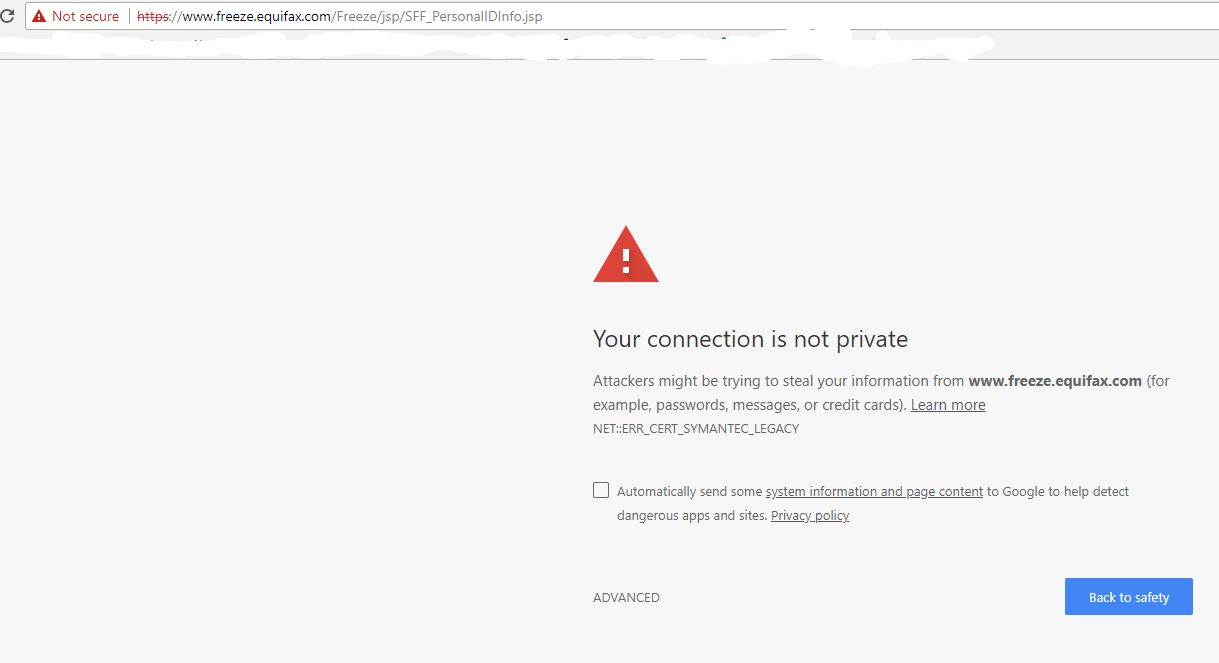
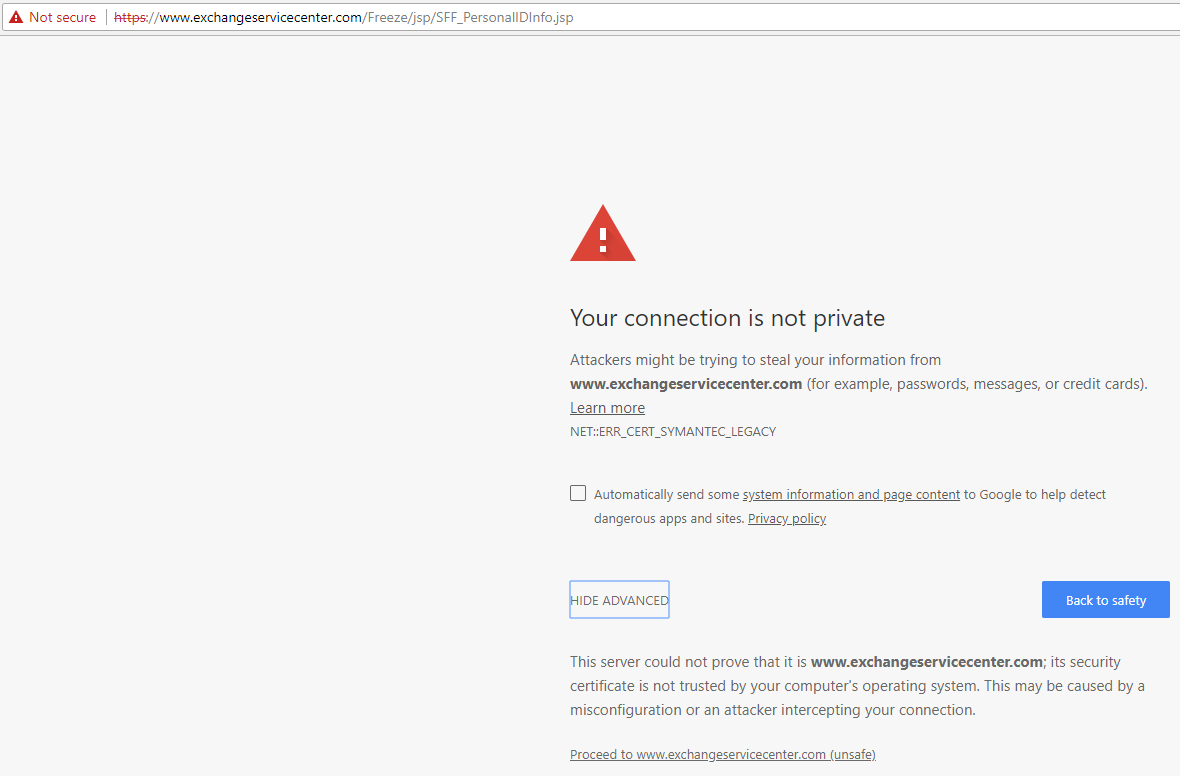
On May 7, when I visited the NCTUE's page for freezing my credit file with them I was presented with the very same connection SSL security alert from Chrome, warning of an invalid Symantec certificate and that any data I shared with the NCTUE's freeze page would not be encrypted in transit.
The security alert generated by Chrome when visiting the freeze page for the NCTUE, whose database (and apparently web site) also is run by Equifax.
When I clicked through past the warnings and proceeded to the insecure NCTUE freeze form (which is worded and stylized almost exactly like Equifax's credit freeze page), I filled out the required information to freeze my NCTUE file. See if you can guess what happened next.
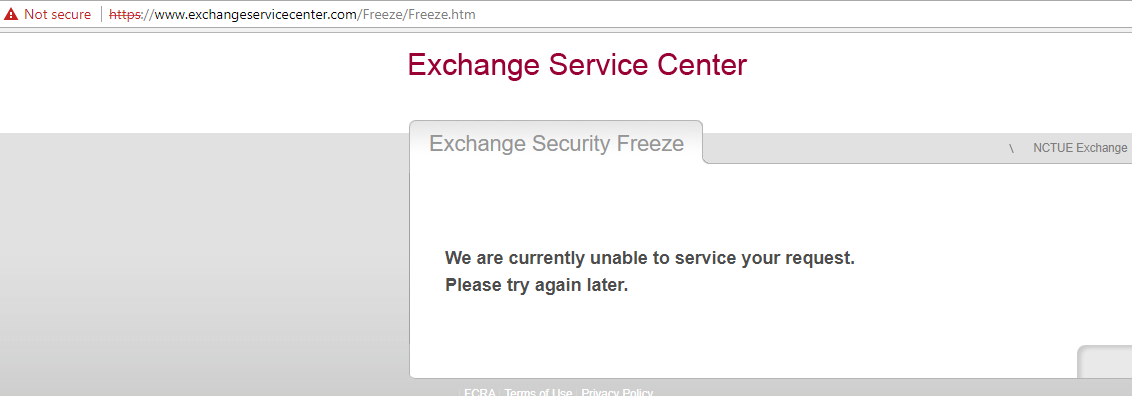
Yep, I was unceremoniously declined the opportunity to do that. "We are currently unable to service your request," read the resulting Web page, without suggesting alternative means of obtaining its report. "Please try again later."
The message I received after trying to freeze my file with the NCTUE.
This scenario will no doubt be familiar to many readers who tried (and failed in a similar fashion) to file freezes on their credit files with Equifax after the company divulged that hackers had relieved it of Social Security numbers, addresses, dates of birth and other sensitive data on nearly 150 million Americans last September. I attempted to file a freeze via the NCTUE's site with no fewer than three different browsers, and each time the form reset itself upon submission or took me to a failure page.
So let's review. Many people who have succeeded in freezing their credit files with Equifax have nonetheless had their identities stolen and new accounts opened in their names thanks to a lesser-known credit bureau that seems to rely entirely on credit checking entities operated by Equifax.
"This just reinforces the fact that we are no longer in control of our information," said Kerskie, who is also a founding member of Griffon Force, a Florida-based identity theft restoration firm.
I find it difficult to disagree with Kerskie's statement. What chaps me about this discovery is that countless Americans are in many cases plunking down $3-$10 per bureau to freeze their credit files, and yet a huge player in this market is able to continue to profit off of identity theft on those same Americans.
EQUIFAX RESPONDS
I asked Equifax why the very same credit bureau operating the NCTUE's data exchange (and those of at least two other contributing members) couldn't detect when consumers had placed credit freezes with Equifax. Put simply, Equifax's wall of legal verbiage below says mainly that NCTUE is a separate entity from Equifax, and that NCTUE doesn't include Equifax credit information.
Here is Equifax's full statement on the matter:
· The National Consumer Telecom and Utilities Exchange, Inc. (NCTUE) is a nationwide, member-owned and operated, FCRA-compliant consumer reporting agency that houses both positive and negative consumer payment data reported by its members, such as new connect requests, payment history, and historical account status and/or fraudulent accounts. NCTUE members are providers of telecommunications and pay/satellite television services to consumers, as well as utilities providing gas, electrical and water services to consumers.
· This information is available to NCTUE members and, on a limited basis, to certain other customers of NCTUE's contracted exchange operator, Equifax Information Services, LLC (Equifax) – typically financial institutions and insurance providers. NCTUE does not include Equifax credit information, and Equifax is not a member of NCTUE, nor does Equifax own any aspect of NCTUE. NCTUE does not provide telecommunications pay/ satellite television or utility services to consumers, and consumers do not apply for those services with NCTUE.
· As a consumer reporting agency, NCTUE places and lifts security freezes on consumer files in accordance with the state law applicable to the consumer. NCTUE also maintains a voluntary security freeze program for consumers who live in states which currently do not have a security freeze law.
· NCTUE is a separate consumer reporting agency from Equifax and therefore a consumer would need to independently place and lift a freeze with NCTUE.
· While state laws vary in the manner in which consumers can place or lift a security freeze (temporarily or permanently), if a consumer has a security freeze on his or her NCTUE file and has not temporarily lifted the freeze, a creditor or other service provider, such as a mobile phone provider, generally cannot access that consumer's NCTUE report in connection with a new account opening. However, the creditor or provider may be able to access that consumer's credit report from another consumer reporting agency in order to open a new account, or decide to open the account without accessing a credit report from any consumer reporting agency, such as NCTUE or Equifax.
PLACING THE FREEZE
I was able to successfully place a freeze on my NCTUE report by calling their 800-number — 1-866-349-5355. The message said the NCTUE might charge a fee for placing or lifting the freeze, in accordance with state freeze laws.
Depending on your state of residence, the cost of placing a freeze on your credit file at Equifax, Experian or Trans Union can run between $3 and $10 per credit bureau, and in many states the bureaus also can charge fees for temporarily "thawing" and removing a freeze (according to a list published by Consumers Union, residents of four states — Indiana, Maine, North Carolina, South Carolina — do not need to pay to place, thaw or lift a freeze).
While my home state of Virginia allows the bureaus to charge $10 to place a freeze, for whatever reason the NCTUE did not assess that fee when I placed my freeze request with them. When and if your freeze request does get approved using the NCTUE's automated phone system, make sure you have pen and paper or a keyboard handy to jot down the freeze PIN, which you will need in the event you ever wish to lift the freeze. When the system read my freeze PIN, it was read so quickly that I had to hit "*" on the dial pad several times to repeat the message.
It's frankly absurd that consumers should ever have to pay to freeze their credit files at all, and yet a recent study indicates that almost 20 percent of Americans chose to do so at one or more of the three major credit bureaus since Equifax announced its breach last fall. The total estimated cost to consumers in freeze fees? $1.4 billion.
A bill in the U.S. Senate that looks likely to pass this year would require credit-reporting firms to let consumers place a freeze without paying. The free freeze component of the bill is just a tiny provision in a much larger banking reform bill — S. 2155 — that consumer groups say will roll back some of the consumer and market protections put in place after the Great Recession of the last decade.
"It's part of a big banking bill that has provisions we hate," said Chi Chi Wu, a staff attorney with the National Consumer Law Center. "It has some provisions not having to do with credit reporting, such as rolling back homeowners disclosure act provisions, changing protections in [current law] having to do with systemic risk."
Sen. Jack Reed (D-RI) has offered a bill (S. 2362) that would invert the current credit reporting system by making all consumer credit files frozen by default, forcing consumers to unfreeze their files whenever they wish to obtain new credit. Meanwhile, several other bills would impose slightly less dramatic changes to the consumer credit reporting industry.
Wu said that while S. 2155 appears steaming toward passage, she doubts any of the other freeze-related bills will go anywhere.
"None of these bills that do something really strong are moving very far," she said.
I should note that NCTUE does offer freeze alternatives. Just like with the big four, NCTUE lets consumers place a somewhat less restrictive "fraud alert" on their file indicating that verbal permission should be obtained over the phone from a consumer before a new account can be opened in their name.
Here is a primer on freezing your credit file with the big three bureaus, including Innovis. This tutorial also includes advice on placing a security alert at ChexSystems, which is used by thousands of banks to verify customers that are requesting new checking and savings accounts. In addition, consumers can opt out of pre-approved credit offers by calling 1-888-5-OPT-OUT (1-888-567-8688), or visit optoutprescreen.com.
Equifax and its ilk may one day finally be exposed for the digital dinosaurs that they are. But until that day, if you care about your identity you now may have another freeze to worry about. And if you decide to take the step of freezing your file at the NCTUE, please sound off about your experience in the comments below.
For some cloud storage tasks, Dropbox is clearly the way to go. But you may want to consider some less high-profile storage services that offer most of the same features, in a more streamlined platform and at a better price. Here are four of the best cloud storage alternatives that you can get for a great deal:
One of the most user-friendly cloud storage services around, pCloud Premium Plus Cloud Storage has earned its reputation as being simple, efficient, and powerful. This one-year subscription lets you store 2TB of photos, videos, music, documents, and more on secure servers. pCloud is also known for its transfer speed (meaning you won't have to wait for hours when you want to access a large batch of data), and you'll be able to sync your files across multiple devices automatically. You'll even have full access to any online media via a built-in HD video and audio player.
The iDrive storage service is being embraced by young entrepreneurs and tech titans thanks to its simplicity and streamlined interface. iDrive is consistently rated right along Dropbox as one of the most versatile and secure storage solutions on the market, and this limited-offer lifetime subscription lets you back up an unlimited amount of data on up to five devices. That means you'll never have to renew your subscription or worry about paying a cent more for extra storage space. Everything you upload to the cloud is protected with 256-bit AES encryption, and you'll be able to easily share files with coworkers or friends via your social media accounts.
Known primarily for its state-of-the-art security, the Degoo Premium cloud service is beloved by data-heavy users who want top-notch security without the high costs. This lifetime plan nets you a whopping 3TB of storage space (that's more than Dropbox, OneDrive, and Google Drive combined) on ultra-secure servers, and lets you send files quickly and easily via email or a separate link. You'll be able to keep your backups automatically up to date thanks to file change detection, and your subscription applies to all of your devices for life.
Zoolz Cloud Storage offers a uniquely customizable storage experience at an incredibly low price. This lifetime subscription comes with 1TB of instant vault storage (for files that you need to access more frequently) and an additional 1TB of cold storage (for files that you rarely visit). This means that you'll have easy access to your go-to data with an integrated Smart Selection tool, and access to your less-visited files in roughly three hours. Zoolz also offers a slew of advanced features like bandwidth throttling, icon overlay, file retention, and more.
It has become the most popular, most sought-after, and most studied GM engine of the 21st century. Yet we can trace the GM V8 LS family – Gen III and IV – with a nearly straight line right back to the origins of the 265 small-block Chevy that made its debut in 1955.
Finally! A Performance Cylinder Head for Ford Six-Cylinders
Six Power: The first look at Vintage Inlines' new aluminum six-cylinder head
Mustang Monthly
How To Engine
Dave Stribling
April 6, 2018
Since the first Mustangs and Falcons were purchased secondhand, gearheads have been pondering whether to build up the straight-six workhorse economy engines or swap out the six in favor of a V-8. The complexity of the conversion to V-8 power, while much easier in the '60s cars, was still a little much for some, and the performance upgrade parts for the six-cylinder were sporadic at best. Plus, there's something to be said for being different and building a smooth-running six-banger.
While there is a six-cylinder performance group today, their part selection has been a blend of old 1960s tech and parts that appear and disappear on a regular basis. One of the reasons for this is very simple: the straight-six was simply not designed for real performance. It was designed to be an economy workhorse that provides reliable day-in and day-out effort getting the small vehicles to and from their destination. They are proportionally heavier than their higher-revving V-8 cousins, with stout blocks and bottom ends that are bulky because Ford didn't need to shave tenths off at the track. The biggest downfall of the six-cylinder was the head itself. With its cast-in uneven port length cylinder head and center exhaust outlet, it was clearly designed for ease of manufacture and not for any kind of performance use. Until now.
Vintage Inlines from Detroit, Michigan, has finally made available an aluminum cylinder head for the inline-six that will really open up these engines to the performance world that was not there before. The story about how this cylinder head came about is fairly long. Mike Winterboer was the owner of Classic Inlines, a company that specialized in six-cylinder performance. He had worked in developing an aluminum head down in Australia, with the intent of bringing it to the States. Mr. Winterboer passed away in 2015. He did finish the project, but it is unknown how many were available or sold. With his passing, a large force behind the six-cylinder performance movement faded.
Enter Matt Cox and Vintage Inlines. Matt is a long-time six-banger enthusiast and was able to acquire some of the inventory and items from Classic and keep the flame going. Although the tech was acquired, getting foundries to work with you can sometimes be a challenge. There are all the issues with working on something new and working it to make it a viable product. Matt was able to contract with the original foundry, and even though there were a few "relearning" issues, they were able to produce the cores. We have all seen press releases about a new product that turns out to be a fishing expedition and doesn't really exist. Vintage Inlines has stuck to it and has succeeded, and the stack of heads on a cart during our visit was proof that this is for real and a huge leap forward for the inline enthusiast.
Head Design The Vintage Inlines head is based on the Australian 250-2V head, which came with a detachable intake manifold, the single most important improvement to the cast-iron originals. The intake ports were raised in the head to provide better flow to the larger valvetrain. Weight savings is nearly 50 percent, with the stock head checking in at 46 pounds and the Vintage head at a svelte 26 pounds. Care was taken to allow for stock components like valve covers and rocker arms, and even the stock exhaust manifold to bolt up to the head. The only thing that was changed was the water temp sender, and that the head uses ARP head studs to attach the head to the block.
Intake With the detachable intake design, you now have a means of running a much more balanced intake arrangement. The original ran along a single pipe and dumped into each port. Right angles are bad for flow, and the center cylinders flowed much easier than the ones on the end, which took a much longer path. In the '60s Offenhouser designed a 3x1 barrel carburetor setup that is still available today (Vintage Inlines part number OFF-200-3X1) that attempted to curb the problems of end cylinder starvation, and it does work somewhat. Adapters for two- and four-barrel carburetors are also available, but they don't get around the inherent problems of the flaws in the cast-in intake.
Vintage Inlines sells a spider-style, bolt-on intake designed for a standard four-barrel carburetor to mate specifically with the alloy head with a much smoother sweeping runner design to even out the flow to the outer cylinders. They have also installed fuel injection bosses on the tops of the raised intake port, making sequential fuel injection a reality. The stock Australian mounting points mean specialty goodies from Australia, like Weber carburetion, are also possible, and stack injection is a very easy fabrication.
Combustion Chamber The stock head has an open chamber design that varied between 52 cc to 62 cc in size. Coupled with dished pistons it didn't make much compression. The new heads are a closed-chamber design with chamber size of 55 cc. Coupled with a flat-top piston this will make a compression ratio in the range of 9.3-9.4 to 1.0. Perfect for today's watered-down fluid we call "gasoline." Vintage leaves plenty of material available for unshrouding of the valves and increasing the chamber size if desired.
Stock intake valves ranged from 1.680 to 1.750, and the exhaust remained constant at 1.380. Vintage has boosted the intake up to 1.800 with an optional 1.840, and the exhaust is increased to 1.500. Stock 289 heads came with 1.780 and 1.450, and 351W came with 1.840 and 1.540, a healthy upgrade to the original six-cylinder arrangement.
Exhaust Ports Another big detriment to the stock heads was the exhaust ports. The center two exhaust ports came together in a Siamese configuration, probably for no other reason than to make it cheaper to manufacture. This big space not only allowed for pressure differences between the center ports and outer four ports, it allowed for additional heat to be retained in the area right under the carburetor, heating up the fuel and causing some warping problems with the head. Aftermarket spacers were devised to solve the problem with the stock heads, but the aluminum head has been cast to eliminate this problem entirely. Ports are healthy and still have enough material to port-match to your headers. As noted before, the awful stock exhaust manifold single outlet will actually bolt up to the cylinder head, if you found yourself having to do that.
Valvetrain Since the six-cylinder was an economy engine, it was fitted with single-coil valvesprings and those not-for-performance two-piece retainers. The new heads come with a choice of a single spring with a damper or a dual spring, depending on your application, and Clay Smith one-piece spring retainers. The bigger valves are Port Flow stainless and the heads are fitted with steel valve guides. The head is designed to be compatible with the stock rocker arm shaft and rocker arms, but can be fitted with full roller rockers should the need call for them.
Production The heads are now being cast on the West Coast and are being shipped to Automotive Machine, in Fraser Michigan, for all the machine work needed to prep them for sale. Just like any other aluminum head, an engine builder can massage these heads for even more performance, with the exception of the area around the valvesprings. This has been optimized for full use of the newer springs. As mentioned before, all your stock or aftermarket goodies like headers, valve covers, and chrome goodies will come right off your old engine and bolt to this one.
As far as performance, the ball has just started rolling on the new heads and they are being delivered. It is not unheard of to make 500 horsepower with all that typical inline torque, and there is a car currently running in the mid-10s with this head and turbocharging—so real performance and even more potential future performance is in your hands. Before you start looking at that list of items to swap a V-8 into your Mustang, take a good look at the new Vintage Inlines aluminum cylinder head for your sturdy six. It gives you all the benefits of the V-8 and inline-six combined.
It has been a 10-year journey, but the aluminum head for the 200 and 250 inline six-cylinder engines is finally here. Vintage Inlines is making the performance upgrade a reality to all the six-cylinder performance junkies, and we should now get a wave of new products to enhance this gem even further.
The head is based on the Australian 250-2V head that has a removable intake manifold. The ports are raised on the aluminum version to increase velocity.
With the removable intake, the new Vintage head eliminates all the issues associated with the horrible design from the factory (right). Small runners and right angles are gone.
Vintage Inlines has a free-flowing intake manifold that bolts to the new head with a standard four-barrel carburetor base. Adapters to run two-barrel carburetors and Weber carburetors are also available. With this setup you can also run fuel injection with a carb-style throttle body.
Also available is a manifold that adapts three side-draft Weber carburetors to the head for maximum port equalization.
The four-barrel manifold is cast with bosses for running fuel injection, nitrous, methanol, or whatever you want to port to the intake.
The head is also cast with bosses for injectors, so sequential injection is a real option for these heads.
Combustion chamber comparison shows the closed-chamber design (top) versus the original open-chamber head (bottom). There is plenty of material around the visibly larger valves for further shaping.
Combustion chambers check in at 55 cc and include stainless steel 1.800-intake and 1.500-inch exhaust valves. That's bigger than stock 289 V-8 valve sizes.
Steel valve guides are used in the production heads and the ports have plenty of material for porting.
The stock head on the bottom shows the Siamese center exhaust ports that really caused issues on the exhaust side. The aluminum head eliminates this problem by casting the ports separately.
Matt states the exhaust ports are fine for most applications, but there is plenty of material to port-match to your headers. Stock manifolds will also work.
We have had many different six-cylinder header designs, and all of them work as advertised. The aluminum head will accept any headers that will fit the stock heads, like these stainless steel 3 into 1x2–style headers from Vintage (PN FSP-200-DOH).
Valve seat areas are maximized to handle the bigger springs. Clay Smith retainers are used exclusively.
Automotive Machine in Fraser, Michigan, has been handling the final prep on the batches of heads that come in. They have experience in both small runs and high performance engines; the exact combination needed to get these to market. These heads have been long awaited, and once they hit the street in numbers you can bet more performance goodies will show up on the market.